
Taming Left Turning Tendencies: Part Three, P-Factor
P-factor, or asymmetric propeller loading, mainly occurs when the airplane is at large angles of attack. As the propeller disk tilts upward during a climb, the descending blade on the right side takes a larger bite of air than the ascending blade on the left. This causes greater thrust on the right side of the spinning propeller disk than on the left, resulting in a yaw to the left. This force becomes noticeable as the pitch angle increases during takeoff, and pilots counteract the imbalance with coordinated rudder input. The effect becomes more significant during flight at large angles of attack and a high power setting.
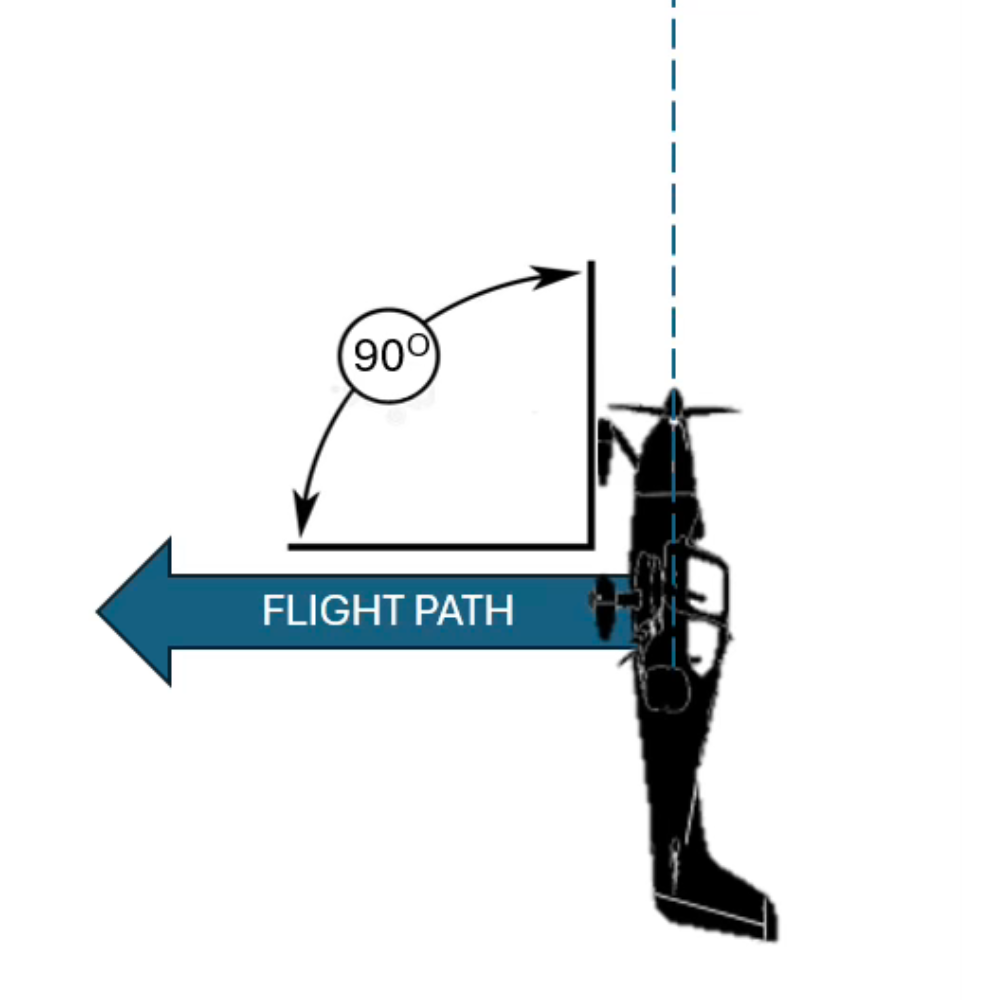
Although we usually describe P-factor within the normal flight range, it can be helpful to imagine an exaggerated scenario to better understand what’s actually happening. Visualize an airplane flying with its fuselage pointing straight up — at a 90-degree angle of attack, similar to a helicopter in flight. In this position, the propeller no longer moves forward through the air in a level plane; instead, it acts like a large, tilted disk pushing air directly downward. The descending “advancing” blade (on the pilot’s right) moves forward relative to the aircraft’s flight path, experiencing much higher relative wind speed and producing significantly more thrust. Conversely, the ascending “retreating” blade (on the pilot’s left) moves backward relative to the path, generating much less thrust. This creates a large yawing force to the left — an exaggerated version of what actually occurs during climb.
Of course, fixed-wing airplanes do not fly at anything close to a 90-degree angle of attack for more than a moment (unless performing at an air show), but this thought experiment helps clarify why the effect grows stronger at steeper attitudes. The greater the tilt between the propeller plane and the relative wind, the larger the difference in blade angles of attack and airspeed — and thus the greater the asymmetric thrust. Even in a shallow climb, the physics remain the same, just on a smaller scale.
At lower-pitch attitudes, such as during level cruise, the propeller disk meets the oncoming airflow almost head-on. Each blade’s angle of attack and its speed through the air are nearly identical, producing symmetrical thrust. However, as the pilot raises the nose, the descending blade’s motion combines with the airplane’s forward speed to create a higher relative wind and a larger angle of attack, while the ascending blade encounters less. These unequal forces cause a subtle but noticeable left yawing tendency, requiring right rudder to keep the aircraft coordinated. Observant pilots might notice that the opposite occurs during descent: slight left rudder is needed.
Some aircraft manufacturers incorporate partial compensation — such as offset engines, right-thrust alignment, or slightly canted vertical stabilizers — but these solutions are only effective at certain combinations of power, airspeed, and angle of attack. Every pilot still needs to manage P-factor actively, especially during climb, slow flight, or go-around phases where high power and large angles of attack are common.
Recognizing P-factor as distinct from torque, slipstream, and, as I’ll discuss next month, gyroscopic precession, clarifies both its origin and how to counteract it. Whether you picture the airplane climbing at a natural 10-degree angle or in that creative vertical “helicopter mode,” the core concept remains the same: uneven blade airspeeds and angles of attack produce uneven thrust. Understanding this relationship — and employing precise rudder coordination — turns a mechanical explanation into a practical skill: flying balanced and true, even when your propeller seems to pull you to the left.
